
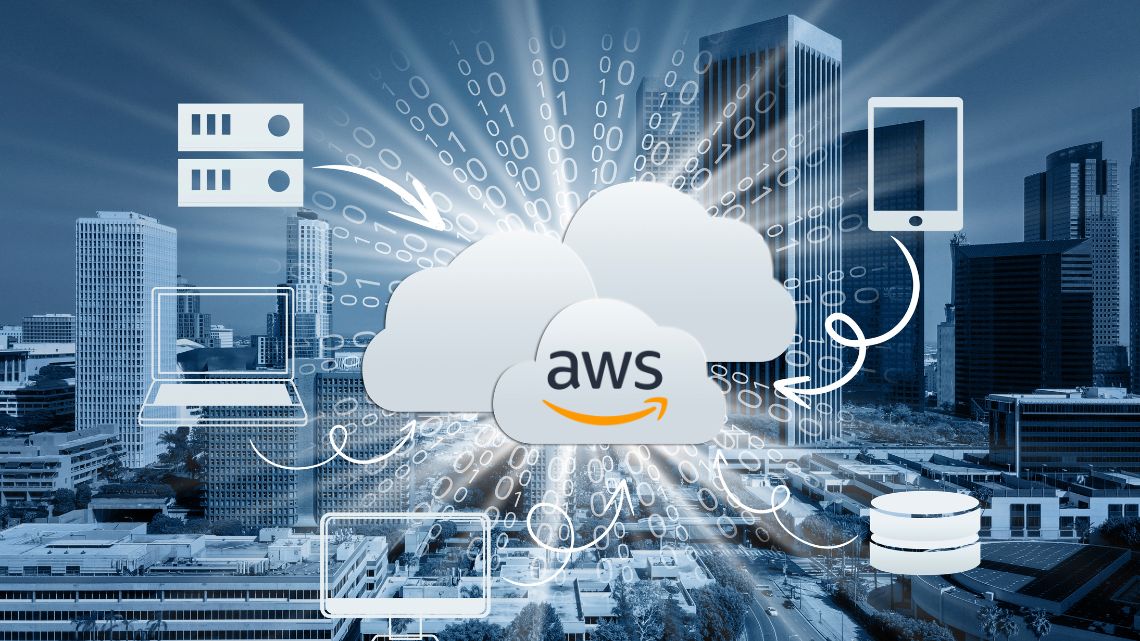
Cloud computing is emerging as a foundational enterprise infrastructure that allows organizations to operate at scale, accelerate innovation, adapt decisively to market volatility. Among the diverse platforms, AWS Cloud Computing has become one of the world’s secure and comprehensive adopted platforms, that sets new benchmarks for cloud computing operations. AWS enables companies to improve financial efficiency, enhance operational velocity, streamline risk management and help them become anchored in long-term global competitiveness. This blog explores what AWS cloud computing is, its emergence, features and ways it drives value in a digitally driven business landscape.
What is AWS Cloud Computing
AWS (Amazon Web Services) cloud computing is an in-demand cloud platform, offering computing power, storage, networking, databases, and over 200 industry specific full featured services through the internet. In 2026, AWS has become a top market differentiator, utilized by both government and enterprises of all scales from startups to tech titans. By providing cutting edge tools such as generative AI, IoT and ML, integrated solutions for industry specific requirements, scalability and accelerated innovation, It has emerged into a full stack platform across the business ecosystem.
AWS cloud offers a facility of virtual servers, management environments for testing and developing applications, and enables organizations to streamline operations at a more accelerated pace without heavy expenditure on hardware and internal infrastructure. The users can access the services with a “pay-as-you-go” pricing model, based solely on what they consumed, allowing to redirect cost savings to strategic areas.
Core Features of AWS Cloud Computing
- Scalable and Elastic Infrastructure
The AWS cloud is a highly scalable cloud that has the ability to scale workloads up and down based on demand. In addition, it provides the same level of capabilities for organizations when they need to expand their potential for seasonal demands or tackle larger enterprise-wide digital platforms. It enables management without any additional effort for sustaining service performance.
- Pay-As-You-Go Pricing
AWS’s pricing model is based on usage. Organizations no longer need to have large amounts of money upfront to use AWS services; instead, they pay an Operating Expense (OPEX) each month as they scale their cloud usage and create a predictable monthly expense based on the amount of usage. The model allows organizations to connect their IT spending to business results directly.
- Global Infrastructure
AWS has a global infrastructure made up of data centers that are located in different regions and Availability Zones. This setup allows AWS to provide high availability, disaster recovery, and deploy applications to customers around the world such as spatial computing for 3D centric applications while providing a reliable service and ensuring business continuity.
- Wide Range of Services
AWS technology in business has a very broad range of services (compute, storage, database, networking, analytics, AI/ML, IoT, and application development) allowing organizations the ability to be creative without needing to manage multiple vendors or platforms.
Key Benefits of AWS for Businesses
- Cost Efficiency and Financial Agility
AWS in business removes the need of infrastructure ownership and related massive upfront costs with a pay as you go operational model. Businesses have the opportunity to only pay for the benefits they specifically choose, such as storage, resources, and bandwidth. The user aggregation enables AWS integrations to provide low variable costs. Advantages of an impressive pricing model help organizations to achieve better cash flow balance, cost control, financial stability and allocate the capital wisely for more strategic priorities.
- Operational Resilience and Scalability
AWS is designed as a globally distributed and fault tolerant infrastructure to effectively evolve with the demand shifts while maintaining performance standards. For example, Amazon EC2 auto scaling adjusts by aligning the demand, enabling companies to streamline scaling out and or removing based on defined policies and maintaining cost efficiency and availability. The capacity to mirror data throughout a range of redundant, geographically isolated regions and Availability Zones, it provides rapid data recovery during unprecedented crises like a natural disaster.
- Faster Time to Market
AWS enables businesses to bring new products and services to market faster than ever before by offering seamless application deployment capabilities. Therefore, organizations can quickly test new solutions, develop and iterate, release them to customers at a much quicker pace, providing organizations with the agility to react quickly to changing customers’ needs to accomplish a competitive edge in the market.
- Enhanced Security and Risk Management
AWS has built security including automated protection, compliance, encryption and control within its core offering and has established security as an enterprise-grade standard throughout the entire platform. It offers encryption, identity management tools, continuous monitoring, and compliance with global standards, allowing to anticipate security risks while ensuring trust and reliability for data storage, and protection for sensitive information.
- Innovation Enablement and Competitive Advantage
AWS enables organizations to innovate continuously by providing organizations with access to cutting-edge technologies (analytics, artificial intelligence, machine learning, and automation). As a result, organizations are able to create industry specific differentiated products, improve operational efficiencies, and establish a sustainable competitive advantage.
Conclusion
AWS Cloud Computing is a key part of today’s corporate strategy. Combining scalable infrastructures along with strong security, global distribution, continuous innovation and support, AWS empowers businesses to transform their operations, control expenditure and scale quickly even during both digital technology complexity and intensifying competition. In this respect, AWS is not just a cloud service provider; rather, it offers businesses a strategy for ongoing innovation and ongoing resilience through the development of its technological solutions.
To read more, visit APAC Business Standard.
For Connect with Us:
About Us: https://about.me/apacbusinessstandard/
Pinterest: https://in.pinterest.com/apacbusinessstandard/
X (Twitter): https://x.com/Apac_b_standard
linkedin: https://www.linkedin.com/company/apac-business-standard/
Facebook: https://www.facebook.com/ApacBusinessStandard
Instagram: https://www.instagram.com/apacbusinessstandard/
Medium: https://medium.com/@apacbusinessstandard
BlogSpot: https://apacbusinessstandard.blogspot.com/