
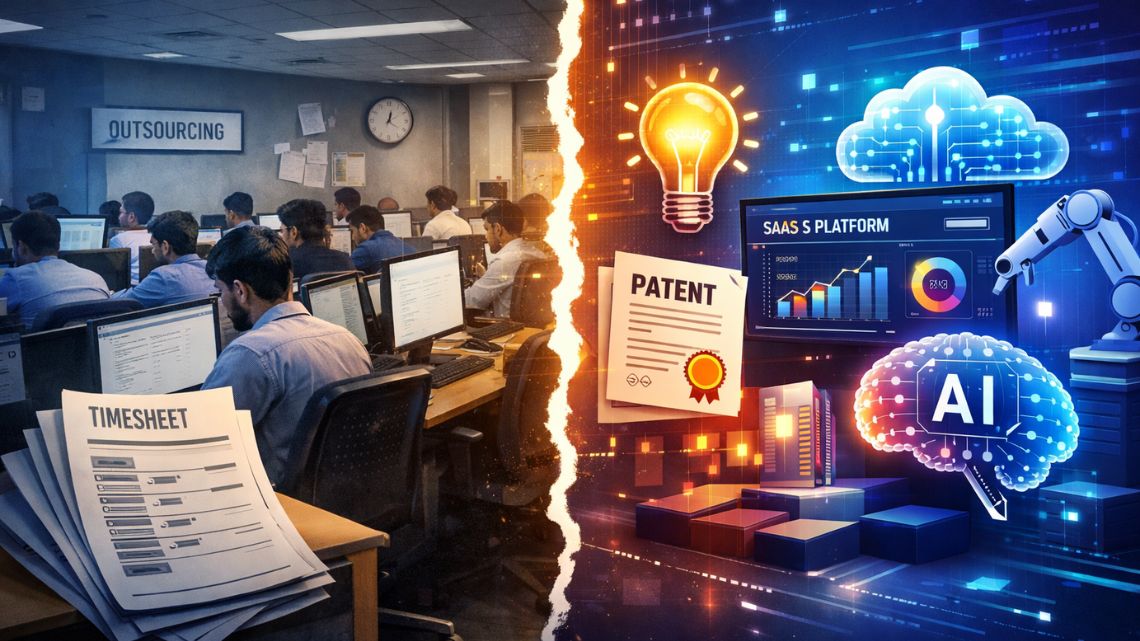
The $250 Billion Identity Crisis: The Great Indian IT Midlife Crisis
For nearly three decades, the Indian IT services industry—spearheaded by monolithic, campus-building giants like TCS, Infosys, Wipro, and HCL—operated under a highly successful, almost industrial model: staff augmentation. The pitch was simple, elegant, and ruthlessly effective: world-class talent, competitive wages, and the ability to scale up a 500-person development team overnight. In the global corporate vernacular, they were the world’s most reliable, high-volume “body shops.”
This model didn’t just fuel corporate growth; it built the modern Indian middle class. But this immense, $250 billion export engine is now facing an existential strategic imperative—the industry’s Great Midlife Crisis. As global clients demand more than just headcount and the very nature of digital work changes, India’s IT majors must shed their identity as outsourced labor providers and reinvent themselves as owners of proprietary Intellectual Property (IP).
The pivot is clear and unforgiving: move decisively from low-margin time-and-materials contracts—where success is measured by hours billed—to high-margin recurring revenue from scalable products and platforms—where success is measured by IP value.
The Financial Pressure: The Vise Grips Tighten
This strategic shift is not motivated by idealism or a sudden burst of innovation; it is driven by cold, hard, non-negotiable financial mathematics. The traditional service model is under pressure from three accelerating forces that make the status quo untenable:
- Margin Compression: The Cost of Being a Commodity: The core profit margin on staff augmentation is continually compressed by global competition. Every year, a dozen smaller, hungrier firms crop up, undercutting prices. Moreover, clients are getting smarter, building better in-house tech teams, and demanding more flexible contracts. Revenue still climbs, but the profit margins remain stubbornly flat—a sign of commoditization that limits shareholder returns and future R&D investment. If you are selling time, someone else can always sell cheaper time.
- The Automation Threat: The Script That Eats Your Lunch: This is the most brutal force. AI and Robotic Process Automation (RPA) are automating the exact tasks that formed the “bread and butter” of the offshore model: legacy system maintenance, simple testing, data migration, and routine support tickets. Why pay a junior developer $X an hour to execute a repetitive task when a script costs literally $0.01 per minute? The very foundation of the labor arbitrage model is crumbling beneath the efficiency of generative AI.
- The Labor Ceiling: The High Cost of Genius: The arbitrage advantage of a vast, lower-cost workforce is meaningless when the project requires niche expertise. The global cost of acquiring and retaining a deep AI/ML engineer, a quantum computing specialist, or a complex security architect is high everywhere, including in Bengaluru and Mumbai. The competitive edge is no longer in volume but in niche expertise, forcing companies to pay global rates and nullifying the old “cheap labor” narrative.
To escape this tightening vise, the corporate mandate is simple: stop selling fish (labor) and start selling fishing nets (IP platforms).
The New Corporate Strategy: Acquiring the Moat’s DNA
The major Indian IT firms are now aggressively executing a multi-billion-dollar, four-pronged strategy to build their IP moats. They are spending capital that previously would have gone toward building the next massive campus footprint on acquiring technology and expertise.
1. The Platform Gambit (Owning the Cloud)
The core idea is to shift from “Build for Me” to “Subscribe to Mine.” Instead of helping a client construct a unique, custom platform—a temporary revenue stream—the new strategy is to develop and sell ready-made, highly scalable, subscription-based solutions.
Example: Instead of billing 50 developers for 18 months to custom-code a bank’s fraud detection system, the company sells its proprietary AI-Powered Fraud Detection Platform on an annual subscription model, charging based on transaction volume. This converts a finite project into a stable, high-margin long-term annuity, dramatically increasing profitability per client.
2. Strategic M&A (Buying the Expertise)
The fastest way to acquire the necessary high-margin DNA is to buy companies that already possess it. Indian IT giants are engaging in massive Mergers & Acquisitions (M&A) focused almost exclusively on niche SaaS providers and specialized consulting firms in the US and Europe.
- The Target Profile: Firms with proprietary software, established relationships in high-value niche sectors (e.g., complex pharmaceutical compliance, ESG reporting systems, deep cloud infrastructure), and a verifiable history of recurring revenue. These acquisitions instantly inject product-centric thinking, client trust, and high-margin IP ownership into the core business, accelerating the pivot by years.
3. The Grand AI Re-Skilling (The Brain Transplant)
The largest internal investment is in re-tooling the workforce—a challenge sometimes jokingly referred to as a “Brain Transplant.” A service-first organization is culturally and structurally built around efficient resource allocation (project managers, hierarchical command); a product-first organization is built around R&D, continuous agile development, and scaling IP.
The firms are pouring billions into upskilling their massive workforces away from legacy maintenance and toward AI, Generative AI, and complex data engineering. The ultimate goal is to transform the average employee’s role from an “implementer” of someone else’s code to an “owner” of proprietary IP assets that can be licensed to hundreds of global clients.
4. The Bespoke Boutique (The High-End Niche)
Recognizing that not all consulting can be automated, the majors are also carving out small, elite “Bespoke Boutique” units. These units focus on ultra-high-margin, complex strategy and digital transformation consulting (e.g., advising a Fortune 100 board on its entire AI strategy). These teams, often staffed with newly acquired top-tier consultants, generate disproportionate revenue, build client trust at the C-suite level, and serve as the essential, human-touch gateway to selling the larger proprietary platforms.
The Culture Clash: From Headcount to Hyperscale
The humorous irony of this pivot is the massive internal cultural whiplash. The decades-old, deeply hierarchical corporate structure—brilliant for managing hundreds of thousands of resources—is now struggling to embrace the flat, fluid, failure-tolerant culture of Silicon Valley product development.
Project meetings now feature veteran managers who understand billing cycles debating product leads who only care about Minimum Viable Products (MVPs) and technical debt. The mantra of “billable hours” clashes daily with the reality of “free R&D time.” It is an organizational comedy of errors, attempting to impose an agile mindset onto a system optimized for scale and stability. This cultural clash is arguably the largest internal risk factor threatening the success of the entire pivot.
The Global Implication: A New Negotiating Table
For clients in North America and Europe, this pivot means the old negotiating leverage over IT services is rapidly fading. Indian firms are no longer desperate to win staff augmentation contracts at razor-thin margins. They are looking for strategic, holistic partnerships where their proprietary platforms and AI tools can deliver superior, faster, and more scalable value.
This transformation is reshaping the corporate landscape of India, shedding its dependence on the volume of labor and securing its future position as a sophisticated global player built not on hours worked, but on the true value of its intellectual property. The “body shopping” era is ending, giving way to the era of the “IP Powerhouse.”