
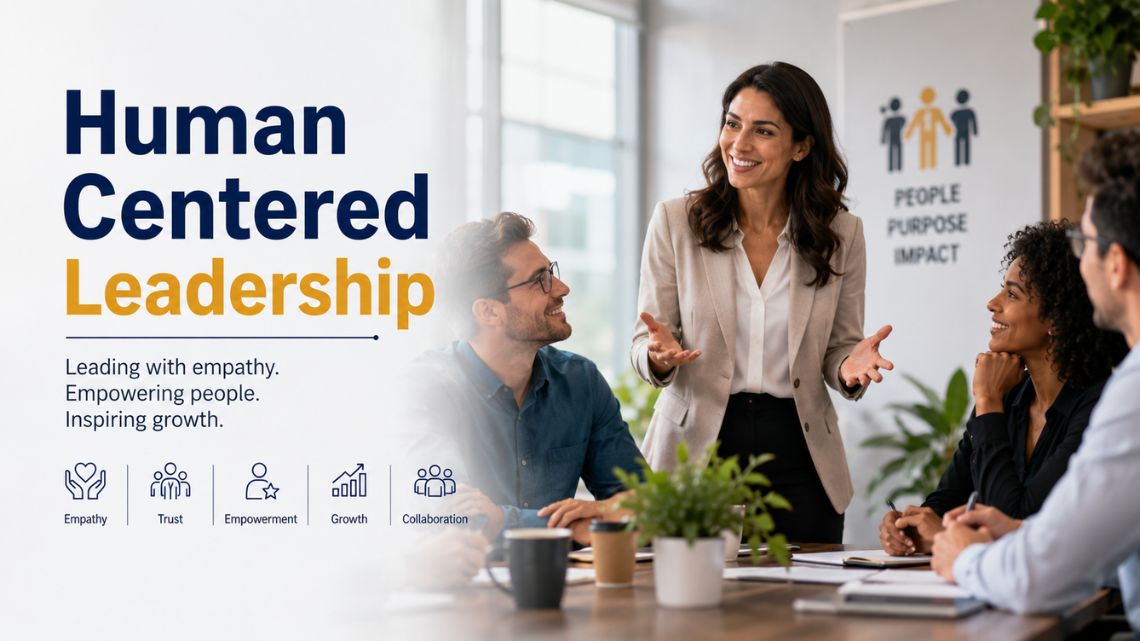
As organizations in this age operate at the confluence of accelerating growth of AI technology, increased hybrid and distributed working environments, and rising employee demand for valuable organizational experiences, pinpoint the requirement of human-centric leadership development. The conventional approaches of leading organizations, especially command, process-focused direction, and performance measurement, are no longer sufficient. In fact, these are undermining the true organizational efficiency to become more agile and be resilient in a rapidly shifting business ecosystem. Therefore, in the years ahead, transformative advantages will not be derived through technological maturity alone but through a pivotal focus on acknowledging employee expectations and workforce dynamics.
What Is Human-Centered Leadership?
Human-centered leadership is a leadership philosophy that defines organizational excellence and success as a cumulative result of a management practice focused on employee well being, empowerment, and growth. At its core, this transparent leadership style prioritizes employee experience and supportive process allocation as strategic instruments to enable enhanced performance outcomes rather than preconditioning for leveraging them as just resource units.
The core principles of people-centric management are:
- People-first decision-making – business decisions are assessed and directed in concern with how it ultimately impact employee wellness and environmental safety.
- Psychological safety – Cultivation of a supportive workplace culture where all the involved parties can experiment and flourish without the fear of failure or authoritative judgment.
- Co-creation – Partner with employees through the avenues of decision and development processes, including redesigning workflows, organizational milestones, and professional development pathways rather than delegation from top-down authorities.
Top characteristic traits of human-centered leaders includes:
- Empathetic discernment: The proficiency to acknowledge and facilitate genuine support to others’ emotions and undercurrents while maintaining clear-eyed judgment and personal boundaries.
- Adaptive governance: Fluency throughout the transitions from directive authority to distributed autonomy as per the context requirements.
- Institutional trust: The ability to build psychological safety within the institutional setting where employees are architecturally encouraged for calculated risk-taking and candid dissent.
- Purpose coherence: It is the ability to create organizational alignment through a purpose-driven vision that ensures consistency with the long term business goals.
Why Human-Centered Leadership Matters in the Digital Era
- Digital transformation is changing workplace culture
- Employee burnout and disengagement in high-tech environments
- The role of trust and psychological safety
- Human connection as a competitive advantage
Building a Human-Centered Workplace Culture
- Prioritizing employee well-being
In the current organizational landscape, it is instrumental for management authorities to rethink well-being as a peripheral concept driven by the allocation of wellness apps and awareness education to toward a core strategic priority embedded within their operational models. Implement mandatory cognitive restoration periods, asynchronous mental health resources, and physical wellness stipends, and implement regular capacity audits to reorganize workloads to prevent employee burnouts. This equips the workforce to outpace distress and perform effectively.
- Flexible work environments
Human centered leaders enable adaptive scheduling, hybrid operating models, and autonomy encouraging policies that accommodate different employee situations, which collectively contribute to increased work-life integration, enhanced productivity, leadership automation, and improved commitment toward the organization, fostering the ability to respond dynamically to the ever-changing and evolving marketplace and the expectations of the workforce.
- Recognition and appreciation systems
This include structured reward systems, recognition timeframes, and equitable incentive programs that validate employees’ contributions to the organization. This reinforce positive behaviors, and increase morale, resulting in increased employee retention, enhanced cultural values, and alignment between individual performance and the strategic objectives of the institution.
- Continuous learning and upskilling
Through ongoing professional development, competency-based training, and providing knowledge-sharing systems that advance employees’ competencies, organizations support attaining the efficiency to adapt to change, drive innovation, and accomplish a competitive edge in a landscape where rapid shifts emerging in technology, economy, and industry.
Future Trends in Human-Centered Leadership: Emerging Trends
- AI-assisted leadership tools
Through the use of predictive insights, AI-enabled systems and executive tools support leaders and managers in making informed decisions by providing accurate strategy, minimizing bias against employees, supporting planning combined skills of employees and establishing a data-driven culture without sacrificing the ability to use human judgment and ensure ethical considerations for organizational governance.
- Skills-first workforce models
“Skills first” is an approach to creating a workforce where skills are the most important factor when hiring. Organizations that focus on building a skills-first model evaluate the ability of employees based on what they can do versus what they have done through credentialed education and experience. These organizations unlock pools of talent for employment, enhance inclusiveness within their workforce, and support workforce agility. In addition, they align both recruitment and development processes with industry and technology changes rolling out in today’s age.
- Purpose-driven leadership
Purpose-centric executive leaders will cultivate employee motivation to achieve high-impact outcomes by leading from a shared set of values, demonstrating transformational leadership qualities of trustworthiness and responsibility with a broader corporate and organizational perspective toward brand reputation, and demonstrating a commitment to long-term corporate social responsibility (CSR) beyond solely financial gains.
- Mental health integration in workplace strategy
Embedding mental health into a company’s overall strategy to build a supportive workplace environment will help companies reduce stigma that people see around mental health, build resilience, increase productivity, create an environment of compassion and support, and place mental health as a key component of the overall strategic priority for the organization.
Conclusion
Human-centered leadership is now evolved as a fiduciary imperative for establishing flourishing and consistently outperforming organizations across objectives such as retention, innovation velocity, resilience, and brand reputation. Although digital transformation has supported an enhanced operational effectiveness, human centricity in strategic leadership—connection, trust, empathy, and meaning—is an integral variable for sustainability and differentiation.
Visit APAC Business Standard for more articles.
For Connect with Us:
About Us: https://about.me/apacbusinessstandard/
Pinterest: https://in.pinterest.com/apacbusinessstandard/
X (Twitter): https://x.com/Apac_b_standard
linkedin: https://www.linkedin.com/company/apac-business-standard/
Facebook: https://www.facebook.com/ApacBusinessStandard
Instagram: https://www.instagram.com/apacbusinessstandard/
Medium: https://medium.com/@apacbusinessstandard
BlogSpot: https://apacbusinessstandard.blogspot.com/