
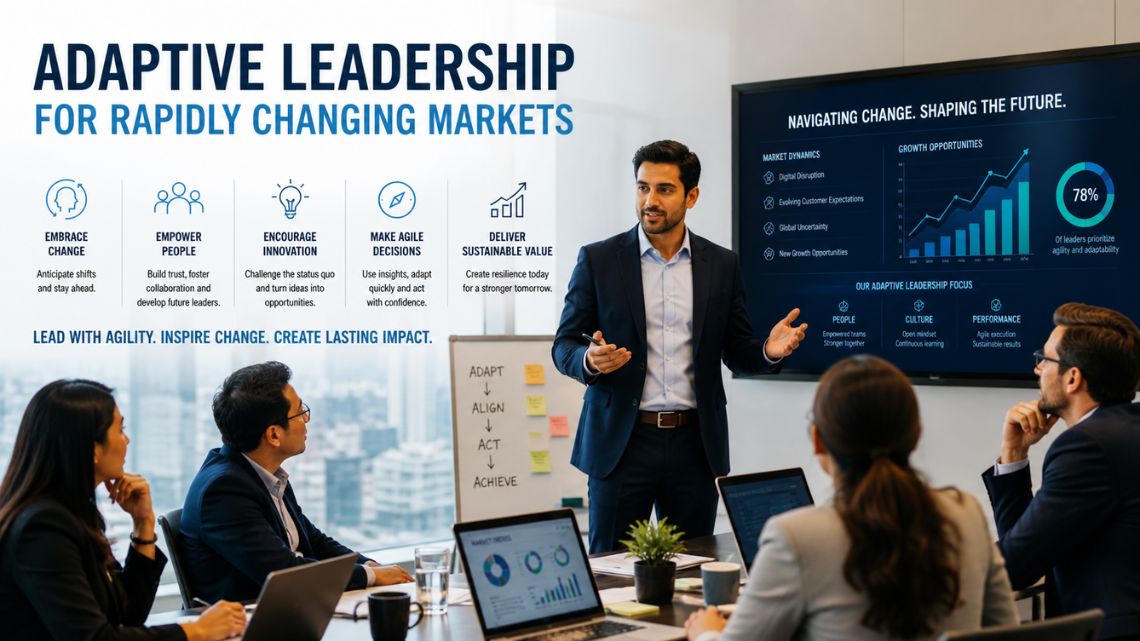
As we move into a period of constant upheaval, rapid advances in technology and globalization have propelled a fundamental shift in the domain of leadership. The traditional leadership approaches, which have been based on predictability and control, are becoming increasingly irrelevant in today’s business landscape.
In an environment marked by volatility, uncertainty and complexity, leaders are required to reinvent themselves as adaptable for anticipating challenges rather than relying on rigid hierarchies and top-down decision making. Adaptive leadership development is essentially an effective method that supports this agenda by providing leaders lean agility, instrumental to respond rapidly and the capacity to make informed decisions when confronted with uncertainty, equipping them to maintain a strategic course.
What is Adaptive Leadership?
Adaptive leadership is an optimized leadership approach, substantially effective in practicing within today’s swiftly shifting business environments. The model focuses on flexibility, learning, and responsiveness against the constant market shifts, emerging business models and technology requirements. Primarily, it is implemented through mobilizing people in order to facilitate an aligned system of strategies, behaviors, and decisions for steering amid the emerging complexity or future uncertainties.
At its core, adaptive leadership is driven by principles such as:
- Continuous learning and iteration
- Openness to change and innovation
- Decentralized decision-making
- Long-term resilience over short-term control
In contrast to conventional leadership models, where authority figures make decisions based on predictability, and established solutions, modern leadership methods such as adaptive style thrives with collective intelligence and ability to pivot quickly. It emphasizes the value of team empowerment and building long term resilience through knowledge, skill enhancements, mindset evolutions rather than short term gains.
Especially when operating in highly complex and uncertain business environments, adaptability across all levels will contribute to effective operations, internal cohesion and evolve with new perspectives and innovation. Fundamentally, the transition from outdated, control based management approaches to leaders becoming more agile with strategy execution, market alignment, and teamwork, enables organizations to anticipate change and harness the emerging opportunities proactively.
Key Traits of Adaptive Leaders
- Agility in decision-making
- Emotional intelligence and self-awareness
- Resilience under pressure
- Empathy and Communication
- Empowerment
- Balancing Stability and Change
How Adaptive Leadership Benefits in Fast-Changing Markets
- Increased Agility
Organizations led by adaptive leaders surpass analysis paralysis and paradox of rigid hierarchies, able to quickly respond to market evolutions, frontline trends, marketing strategies and tackle future challenges. This agility provides a competitive edge to effectively progress and pivot through even in the phase of disruptions.
- Higher Employee Engagement
Change entails adaptation to new roles, technology, upskilling, often creates internal resistance. Adaptive style helps instill and empower accountability within teams and a shared sense of responsibility for organizational success. This eventually drives enhanced performance efficiency and collaborative effectiveness.
- Sustainable Growth
Leadership development through continuous learning will substantially help organizations create a safety net against the unforeseen challenges and lay the groundwork for systemic intelligence. By embracing updating leadership skills and knowledge position leadership authorities for long term success, as they are able to rapidly capitalize on new opportunities, enhancing innovation, and value creation.
Key Strategies for Implementation
- Diagnose the Current Environment
A leader needs to understand the complexity of their operating environment primarily. The strategy is identifying the types of challenges in their environment that require adaptive solutions versus solely technical solutions. When a clear diagnosis exists, then appropriate responses to changing conditions can be executed seamlessly.
- Manage Distress
Change creates uncertainty and resistance. Adaptive leaders manage the tension created by change through establishing focus, defining clarity, and supporting their teams during change without overwhelming teams. The effective management of distress, enables leaders to maintain performance during change.
- Data-Driven Decision Making
In a high stake and rapidly evolving business ecosystem, embedding data dashboards, feedback loops etc. as a core strategy will enable leaders to streamline informed decisions. By integrating timely insights for decision-making, it reduces the dependence on assumptions or guesswork, and enables sustained agility, navigate business priorities with greater precision.
- Experimentation
Adaptive and transformational leadership demands not merely learning but understanding how to effectively implement them at a fast pace. A culture of experimentation help leaders bridge the gap between strategy and action, translating to increased adaptability. Small-scale tests, acquiring knowledge through multiple iterations, with ongoing feedback loops, organizational leaders can innovate while reducing risk of future uncertainties. Experimentation within culture encourages creativity and expedites improvement.
Conclusion
Adaptive leaders prepare themselves for continuous change by capitalizing it as a key skill set. Organizations utilizing this style are able to establish clarity and confidence when faced with uncertainty, disruptions and efficiently utilize new opportunities. Adaptive leadership allows an organization to build agility by allowing employees to operate with discretion while creating systems that foster organizational maturity in the future. The focal point of adaptive leadership transcends the objective of managing the outcome of an action, but also to develop a process that facilitates continuous responsiveness and sustainability. In the end, adaptive leaders will not only cope with changing market conditions, but will also help influence customers, create long-term growth and competitive advantage.
Visit APAC Business Standard for more articles.
For Connect with Us:
About Us: https://about.me/apacbusinessstandard/
Pinterest: https://in.pinterest.com/apacbusinessstandard/
X (Twitter): https://x.com/Apac_b_standard
linkedin: https://www.linkedin.com/company/apac-business-standard/
Facebook: https://www.facebook.com/ApacBusinessStandard
Instagram: https://www.instagram.com/apacbusinessstandard/
Medium: https://medium.com/@apacbusinessstandard
BlogSpot: https://apacbusinessstandard.blogspot.com/