
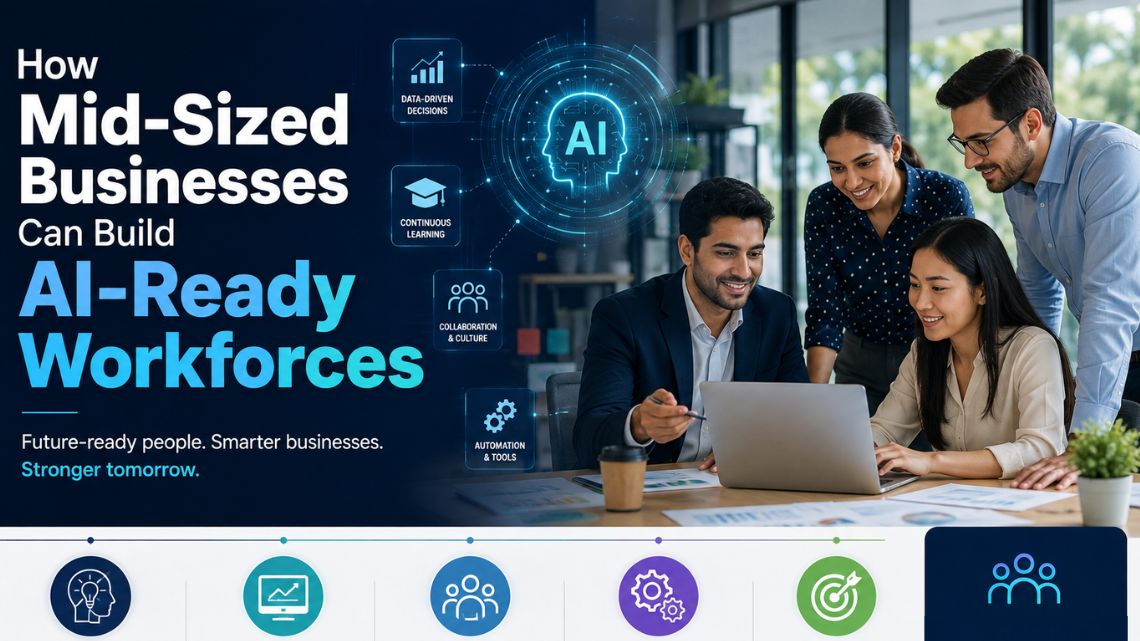
Artificial intelligence has become a competitive imperative for all scales of organizations in today’s ever evolving business landscape. For mid-sized organizations, AI facilitates numerous incredible avenues for augmenting productivity, improving workflows, customer experience and cultivating enhanced efficiency without drastically expanding capital. As AI reforms the expectations of business strategy development and implementation, therefore employees are compelled to become skilled in digital and analytical domains in order to effectively adapt to the emerging workflow advancements.
MSEs often encounter limitations for organizational agility due to budget constraints, legacy systems, and scarcity of demanding technical talent. AI-ready workforce help organizations pivot at a fast pace for new transformations, as they are equipped with the right skills, leadership and organizational culture. This article explores some of the exclusive strategies that enable mid-sized businesses to prepare their workforce for AI-readiness.
Strategies for Building an AI-Ready Workforce
- Assess Capabilities and Define Goals
For small scale and mid-sized organizations, cost is the primary barrier that delays enterprise wide AI adoption. Entrepreneurs should map out their current digital maturity and outline new technology accessibility it requires to transform and cultivate accelerated growth. Businesses must track workforce skills, currently existing technologies and comprehensive business process to identify areas where AI can contribute better efficiency. Small scale organizations must integrate effective AI solutions to automate manually draining repetitive works, solve operational inconveniences, measure performance and enhance financial gains.
A comprehensive analysis of where the company stands and future expectations will support businesses making valuable investments in artificial intelligence that translates employee performance aligned with the organizational priorities while providing a clear roadmap for implementation.
- Deploy Tiered, Role-Specific Training
The conventional model of employee training has become increasingly obsolete in this age of digital transformation and expanding employee expectations. The transformative market evolutions demand employees continuously learn role specific in demand skills and literacy in new tech stacks. In contrast to generic training models, AI driven implementations will help leaders create exclusively personalized learning programs based on assessing employee responsibilities, skill gaps and required end goals across the business functions.
For marketing in business, managers must empower teams with AI powered engagement building tools, while finance teams should focus on predictive analytics and automation. Tailored learning not only equip employees for market ready adaptations but also help them troubleshoot machine bias, automate recurring tasks, and accelerate local tool adoption.
- Establish Clear Governance and Guardrails
Responsible implementation and AI is a key enabler of safe and reliable operations and compliance. By provisioning explicitly defined data security rules, strict usage policies, governance guidance will support employees carefully review, and cultivate formally appropriate AI usage. Businesses must consider resilient governance mechanisms for cybersecurity safeguards, ethical usage, regulatory compliance, and Securing intellectual property rights.
Clear governance policies will help employees improve AI supported decision making, as it maintains human oversight as the central pillar of business intelligence.
- Foster an AI-Friendly Work Culture
In a scenario where technology replacing employment opportunities has expanded, providing them clarity on how technology will augment human capabilities will help leaders create a positive outlook on embracing it in work culture. When organizations positions it as a productivity tool for improving human expertise, empower experimentation and learning, it leads a a tech-friendly culture aligns to the business
Technology adoption is significantly determined as much by culture as by technical capability. Employees are more motivated to adopt AI more readily when leadership demonstrates it as a productivity tool rather than a replacement for human expertise, it initiates for successful AI adoption.
- Equip Managers to Lead AI Transformation
Managers are the primary enablers who direct successful AI transformations within organizations. Middle managers address the technological gaps and integrate role specific AI use cases that resonate the evolving demands and responsibilities. Therefore leadership development in AI literacy, AI-powered marketing, data driven decision making and change management are pivotal for strengthening high value strategic adoption. Organizations must allocate managers effective resources and training support for improving their efficiency to align teams with performance matrics, workflow automation and reduce team resistance during transformations.
How to Prepare for the Future of Work
- Adopt Skills-Based Workforce Planning
With the advancement of AI technology, businesses must start focusing more on employee capability rather than conventional job titles. This modern approach of skills-based workforce planning assists a firm in detecting shortages of talent in the concerned company, training them for facing future challenges, and recruiting talent in areas where they excel.
The adoption of this technique is beneficial in terms of workforce flexibility and allows firms to adjust more quickly to the settings of the evolving market.
- Foster Human-AI Collaboration
The workplace of tomorrow is going to be an ecosystem where humans and intelligent machines work together as strategic partners. Artificial intelligence is efficient in accomplishing ordinary tasks and analyzing large scale data. This allows the human employees to allocate their time for notions of creativity and strategic decision-making.
Businesses that will introduce workflow mastering based on the combination of both human intelligence and machine capabilities will be able to raise their financial indicator with reduced losses in the innovation field as well as in customer relations.
- Create Continuous Innovation
The constant growth of AI technology leads to the necessity of continuous learning and it is becoming an important trait for high performing companies. It is advised for businesses to practice operational development through encouraging experimentation, combined with regular skill development initiatives.
Conclusion
AI-ready workforce has become a crucial edge for small business and mid size organizations to stay competitive. As the intelligent economy accelerates, transitioning toward more tech friendly cultures and talent readiness through building responsible governance, adaptable leadership, and continuous workforce development’s will pave the pathway for long term success. Also, empowering managers, role specific employee training and human AI collaborative frameworks will strategically support mid level organizations to pivot at a faster pace and achieve a lasting competitive advantage.
To read more, visit APAC Business Standard.