
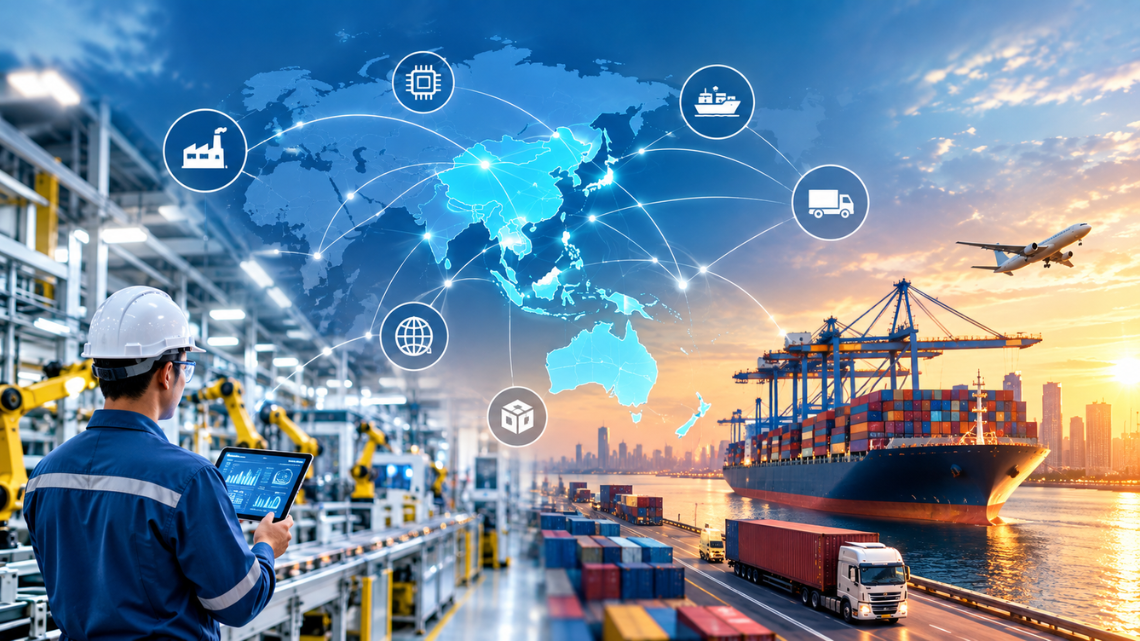
For decades, the logic of Asian manufacturing was elegantly simple: produce efficiently, move quickly, and keep costs under control. That model helped turn the region into the world’s manufacturing centre. But the assumptions underneath it are changing.
Companies across APAC are now dealing with a business environment in which supply-chain decisions are increasingly influenced by geopolitics, export controls, shipping disruptions, energy costs, climate events, changing trade policies, and the strategic ambitions of individual governments. The question for businesses is no longer simply where production is cheapest. It is where production can remain reliable when circumstances change. This is producing a significant shift in corporate thinking, resilience is becoming part of supply-chain design rather than an emergency response.
China Plus One Is Becoming More Nuanced
The “China Plus One” strategy has often been presented as a straightforward move to establish manufacturing capacity outside China. In practice, the picture is more complicated. Businesses are diversifying production across countries including Vietnam, India, Malaysia, Indonesia and Thailand, but few can simply replace one manufacturing ecosystem with another. China remains deeply embedded in regional supply chains through its supplier networks, industrial infrastructure, logistics capabilities, skilled workforce and enormous domestic market.
For many companies, diversification therefore means creating alternatives rather than abandoning existing relationships. That distinction matters. A company might manufacture final products in Vietnam while continuing to source components from China. Another might develop production capacity in India while maintaining Chinese suppliers for specialised inputs. The emerging model is less about choosing one country over another and more about building a network in which no single disruption can bring the entire operation to a halt.
Governments Are Becoming Part of the Supply-Chain Strategy
Industrial policy is also reshaping corporate decisions. Across APAC, governments are competing to attract investment into semiconductors, electronics, electric vehicles, batteries, renewable energy, advanced manufacturing and other strategic industries. Incentives, infrastructure investment and localisation requirements are influencing where companies establish factories and develop supplier ecosystems.
For businesses, this creates opportunities but also introduces another layer of complexity. Government incentives can make a location commercially attractive, but incentives alone cannot compensate for inadequate logistics, unreliable utilities, skills shortages or a weak domestic supplier base. The strongest investment decisions therefore require companies to examine the entire ecosystem rather than the headline incentive.
The Real Vulnerability May Be Further Upstream
Supply-chain risk is often associated with factories and shipping routes. Increasingly, however, the vulnerability lies several layers deeper.
A manufacturer may have alternative suppliers for a finished component but discover that both suppliers depend on the same upstream producer. A company may diversify its factories geographically while remaining dependent on one source of a critical material. This creates the appearance of resilience without genuine redundancy. Supply-chain visibility is consequently becoming a strategic capability.
Businesses need to understand not only who their immediate suppliers are, but also which suppliers those companies depend upon, where critical materials originate, and which parts of the network would be difficult to replace. That requires better data, closer supplier relationships and, in some cases, a willingness to spend more for optionality.
Efficiency Alone Is No Longer the Objective
For years, corporate procurement rewarded lean inventories, concentrated supplier relationships and maximum utilisation. These practices reduced costs and improved efficiency, but they also left little room when disruptions occurred. The lesson emerging from recent supply-chain shocks is not that efficiency was wrong. It is that efficiency without flexibility can become fragile.
Maintaining additional suppliers, holding strategic inventory, developing local capabilities or operating facilities in more than one market may appear expensive when everything is functioning normally. During a disruption, however, those choices can protect revenue, customer relationships and market share. The calculation is therefore changing from “What is the cheapest operating model?” to “What is the most economically sustainable model under different conditions?”
APAC’s Next Supply-Chain Race
The next phase of Asian manufacturing will not be defined solely by factories moving from one country to another. It will be defined by the sophistication of the networks companies build around those factories.
Businesses that understand regional interdependencies, diversify intelligently, develop stronger supplier intelligence and integrate geopolitical considerations into operational planning will have an advantage over those still treating supply chains as a procurement issue.
APAC remains central to global manufacturing. But its importance is evolving. The winning companies will not necessarily be those that manufacture at the lowest possible cost. They will be those that can keep producing when the assumptions behind their business model change.