
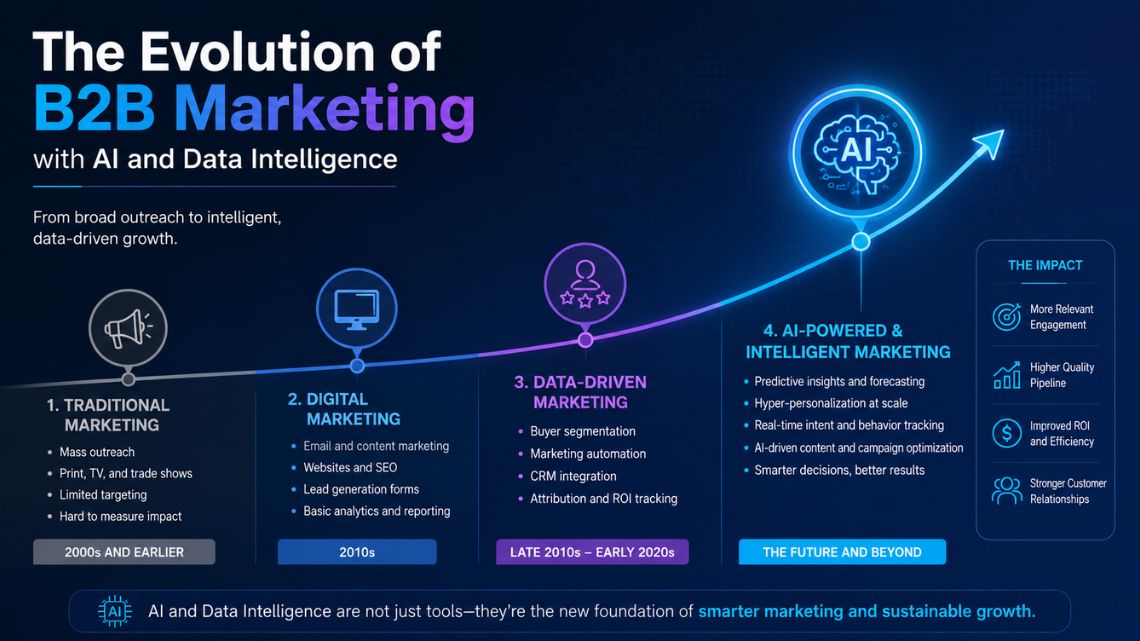
Data intelligence and AI driven orchestration are two of the significant transformations that emerged in the history of marketing, changing the conventional norms of lead generation, targeting and reporting. Beyond the spectrum of generic and broad campaigns, leveraging predictive intelligence, automation and conversational AI agents, enabled marketers to cultivate highly personalized, optimized and ROI driven execution.
Unsegmented lists and identical email calls are no longer effective in today’s era of content saturation. Prospects in the B2B realm values intend driven, tailored account specific marketing that resonates with the buyer personas. Highly personalized experiences contribute to enhanced engagement rate, foster relationships with the target segments. It’s empirical to transition from traditional lead generation models toward data-driven revenue intelligence strategies to successfully translate opportunities into accelerated growth.
How AI and Data Intelligence Are Transforming Modern B2B Marketing
Predictive Analytics
Beyond the concept of intuition driven marketing and reporting, the integration of AI and predictive intelligence enabled organizations to effectively forecast convention potential early, anticipate market demand, while preventing bottlenecks such as customer churn risk. Marketers dynamically adjust lead scoring using changes in the pattern of prospect engagements.
Modern predictive systems can:
- Identify high-intent accounts
- Forecast pipeline performance
- Predict churn risks
- Recommend next-best actions
- Improve lead prioritization
This convenience allows both marketing and B2B sales teams to efficiently allocate strategic implementations with a focus on highest revenue potential. For leaders, analytics strength helps accurately forecast and curate informed insights for high conversion decisions.
Hyper-Personalization at Scale
Personalization has evolved from solely email customization to dynamism throughout the possible touchpoints. This includes changing website imagery, content recommendation and case studies based on the visitor industry codes. AI now enables real-time account based tailored recommendations that aligns to prospects’ behavioral intent across websites, campaigns, and customer journeys.
Organizations can customize:
- Messaging based on industry or role
- Content in relevance to buying stage
- Recommendations based on engagement behavior
- Outreach timing using behavioral signals
By enabling exclusively personalized outreach experiences channeled via artificial intelligence and data analytics, especially in the B2B landscape where multiple stakeholders influence a purchase decision, businesses at any scale can sustain messaging consistently while maintaining brand positioning for stronger engagement and loyalty.
Intent Data and Buyer Signals
In B2B marketing, data intelligence has markedly unleashed a new wave of possibilities for intent driven marketing.
By analyzing behaviors such as:
- Search activity
- Content consumption
- Website engagement
- Competitive research
AI software monitors can detect research activities which accounts are most likely to enter the buying cycle. This shifts in marketing from broad outbound marketing strategies to exclusively prioritized marketing automation approaches centers on real time buyer intent helps attract potential prospects. Personalization also enables enhanced visibility regarding the current market trends, customer priorities, and emerging demand patterns among target segments.
Intent intelligence has become a critical edge in foolproof go-to-market strategy.
Conversational AI and Chatbots
Enterprise buyers are expecting immediate engagements with vendor parties. Through intelligent bots, using NLP. systems can immediately route real time communications directly to qualified buyer accounts. Automation supports aligning schedules with sales calendars, reducing operational friction as well as enhancing customer experience. Transcending the paradigm of bots responding to FAQs and generic messages, now are able to resolve technical and security bottlenecks in real time.
AI-based chatbots can:
- Qualify leads
- Provide immediate response
- Route inquiries
- Schedule appointments
- Provide individualised recommendations
These advantages help eliminate potential friction in customer journey, conversational AI helps sales teams focus on quality contact rather than time-consuming processes.
For businesses, customer service responsiveness and experience are rapidly becoming key competitive advantages.
AI-Powered Content Operations
Content plays a significant role in B2B marketing; however, AI is changing how businesses create and optimize content through leveraging technology intelligence.
Potential applications of AI in content development include:
- Topic research
- SEO optimisation
- Personalisation
- Automated testing
- Performance measurement and analysis
With the rise of AI-created content, differentiating brand marketing becomes increasingly more complex. Brands that differentiate themselves will not merely produce content—they will provide quality insight, greater expertise, and unrivalled thought leadership.
While AI can help companies operate more efficiently, an organisation’s true authority in its industry will continue to be determined by the experience and strategic choices of its employees.
Strategic Challenges & Considerations
- Feature Parity and Brand Importance
With increasing accessibility of AI and saturation, many products and services are reaching feature parity. An exclusive brand voice and identity can influence perception shifts in the audience perspectives, leading to a competitive edge in the market.
Enterprise buyers increasingly evaluate companies based on:
- Strategic vision
- Customer confidence
- Industry expertise
- Thought leadership
Technology adoption alone is no longer sufficient to build competitive advantage in the pace of intensified revelry.
- The People-First Approach
Although in B2B marketing, automation drives the backend tasks, deal decisions involve human trust, risk evaluations, and long-term relationship potential etc. Teams are required to audit, prompt and manage along with AI systems rather than a comprehensive automation outlook or replacement.
The future of B2B marketing highly relies on human upskilling, B2B influencer marketing, creativity and the ability to build authentic relationships.
- Data Unification
AI efficiency solely depends on the quality and precision of data architectures integrated in it. Many organizations are facing struggle with fragmented systems and disconnected customer information.
To maximize AI performance, businesses must invest in:
- Unified customer data
- Cross-functional visibility
- Strong data governance
- Integrated revenue operations
If the integrated data is highly fragmented and inaccurate, AI insights become highly unreliable.
Conclusion
Beyond the conventional marketing paradigms, AI and data intelligence have transformed every dimension of b2b marketing from lead generation to predictive growth. Technological advancements supported marketing teams to strategically convert customer behaviors, personalize engagement, forecast forthcoming trends and opportunities, allow efficient align entrepreneurial marketing to business results. In addition to capitalizing on automation, success will be cultivated by organizations that utilize both AI-driven intelligent systems with strong brand positioning, unified data strategies, and authentic human engagement. The future of B2B marketing will be differentiated through an organization’s ability to convert data insights into transformative value creation aligned to their specific ROI goals.
Visit APAC Business Standard for more articles.
For Connect with Us:
About Us: https://about.me/apacbusinessstandard/
Pinterest: https://in.pinterest.com/apacbusinessstandard/
X (Twitter): https://x.com/Apac_b_standard
linkedin: https://www.linkedin.com/company/apac-business-standard/
Facebook: https://www.facebook.com/ApacBusinessStandard
Instagram: https://www.instagram.com/apacbusinessstandard/
Medium: https://medium.com/@apacbusinessstandard
BlogSpot: https://apacbusinessstandard.blogspot.com/