
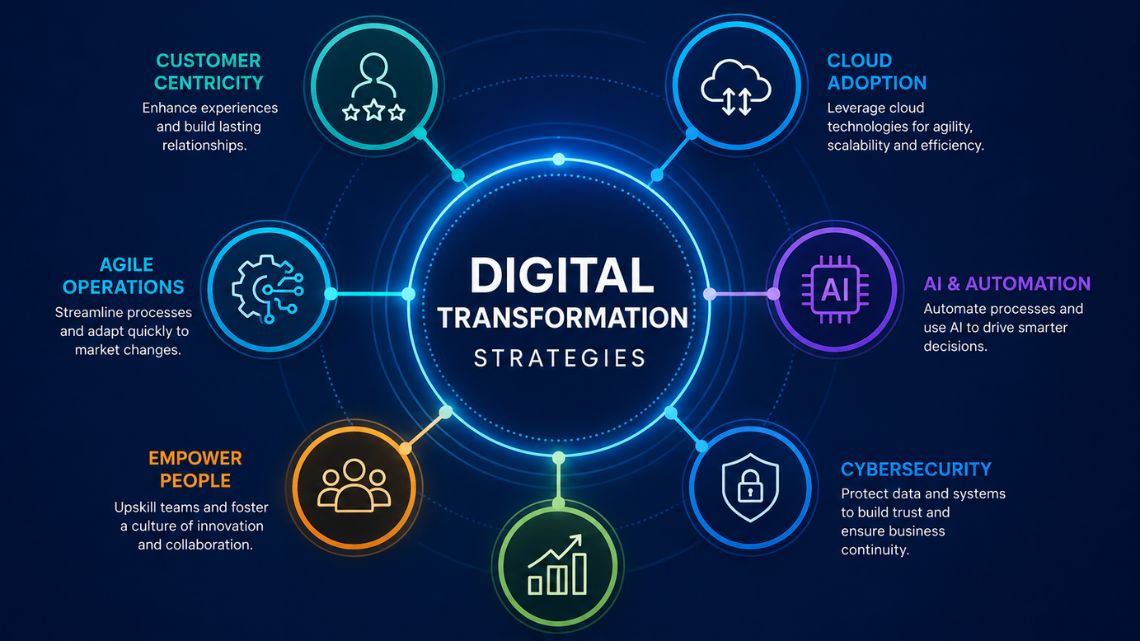
Digital transformation has significantly transformed every facet of business operations beyond automation. It re-architects decision making, data management, and customer engagement by enabling intelligent, autonomous enterprise design. This quiet acceleration by leveraging Agentic AI, cloud native infrastructures, and edge first intelligence equipping companies strategically differentiate themselves in highly saturated markets.
Latest statistics of industry trends indicates that over 70 % of enterprises are emerging in active AI adoption, yet only a fraction of companies are turning into full scale transformation. Creating radical improvements across the operational level will build a digital foundation for agility and rapid change. Digital transformation cannot be achieved through tech adoption alone. It’s necessary for entrepreneurs to develop a well thought out execution strategy that extracts maximum value from digital technology systems. This blog is an executive blueprint that provides actionable digital integration strategies that help navigate the complexities of 2026.
Core Pillars of Digital Transformation in 2026
- AI-First Operating Models
- Data as a Strategic Asset
- Cloud-Native and Edge Infrastructure
- Cybersecurity as a Business Priority
Digital transformation strategies in 2026
- Agentic AI & Workflow Automation
Unlike the solutions of gen AI such as Chatbots, Agentic AI autonomously executes complex tasks across multiple systems. As it makes decisions in a context driven manner, it enables a seamless workflow automation with minimal human intervention. By orchestrating Agentic AI across the workflows, organizations can reduce operational complexity, accelerate process execution, and optimize productivity across different dimensions of process execution. Achieving a fully autonomous, self optimizing operational capability helps position a business ahead of competitors and significantly reduce workforce expenditure with digital leadership.
- Generative Engine Optimization (GEO)
Witnessing the continuously changing google algorithms and the emergence of AI powered search models such as ChatGPT and Perplexity, generative engine optimization has become a cutting edge solution in content marketing. Structuring content in a way that resonates with the data ingestion and citation framework of LLM models will help improve rate of discovery. How a digital agent cites a brand holds significant importance as AI generated results are a critical competitive differentiator. Optimize content for AI-generated summaries, maintain a conversational tone combining long tail keywords, and structure with authoritative formats.
- Hyper-Personalization & ABM 2.0
Generic marketing has become obsolete in today’s ever evolving marketing landscape. When consumers prefer highly personalized brand presence, account based marketing helps maintain a unified segmentation. Providing intent driven personalized recommendations significantly enhance the potential of conversions and engagement. AI based audience segmentation, real time content personalization and precision targeting not only improve performance but also enhance customer experience, translating to long term trust and loyalty.
- Supply Chain & Procurement
Digital transformation is powering supply chain operations from reactive to predictive and autonomous and agile frameworks. The use of Digital twins for simulating supply chain disruptions, enterprises can make safety decisions before the escalation of significant risks. Digital integrations for supply chain management and informed procurement decisions, enables companies to reduce sourcing down time, effectively predict future risks, and safeguard margins against market volatility.
- Predictive Retention
Employing advanced AI driven analytics helps identify customer behavior, employee retention, signs of churn such future disruptions, allows organizations to take proactive preventive digital strategies—personalized outreach, targeted marketing, timely support, etc. These actions lead to greater customer loyalty, longer customer life, higher value creation, and long-term financial stability.
- Zero-Copy Integration and Sovereign AI
Zero-synchronized or ‘zero-copy’ integration allows access to real-time data from multiple systems simultaneously, that facilitates a single ‘source of truth’, which decreases latency and improves efficiency. When combined with ‘sovereign AI’, which maintains data governance while storing and is in alignment with regional governance frameworks. This provides organizations a feasibility to ensure data compliance in adherence to privacy, extraction and storage laws. Having strict data governance, improved data security and compliance with regulations will help businesses achieve robust data management and utilization strategy.
- Real-Time Intelligence
AI driven data and predictive architectures provides organizations a provision to analyze real time data insights, contributing to enable instantaneous decision making. By streamlining data analytics as a strategic catalyst, businesses are able to facilitate enhanced interactive experiences, resolve operational hurdles such as response wait time while improving agility and optimizing performance. Therefore, Real-time intelligence is enabling organizations to orchestrate flexible, real-time, and dynamic customer experiences.
- Digital Sales Rooms (DSRs)
Digital Sales Rooms (DSRs) are centralized, interactive systems developed to enhance B2B buyer engagement. DSRs provide personalized content delivery, real-time communication, and collaboration among all stakeholders during the buying cycle. By providing a seamless experience throughout the buying and selling cycle, DSRs enable faster decisions, stronger relationships, and marked improvements in conversion rates and selling efficiency.
Conclusion
In 2026, Digital Transformation Strategy is characterized by extensive integrated use of AI, strong data foundations, while providing the ability to operate in real-time. Digitally adapting organizations will be able to operate with higher levels of intelligence and enhanced agility. Organizations who invest in goal aligned intelligent technology solutions into their core functions—create unified and scalable data ecosystems, position cybersecurity and compliance a top priority, and enable highly personalized CX will outperform others. Enterprises who proactively leverage these advancements will not only be able to adapt to changes, they will also establish industry leading positions in an intelligent, data-driven, and highly interconnected digital entrepreneurship landscape.
Visit APAC Business Standard for more articles.
For Connect with Us:
About Us: https://about.me/apacbusinessstandard/
Pinterest: https://in.pinterest.com/apacbusinessstandard/
X (Twitter): https://x.com/Apac_b_standard
linkedin: https://www.linkedin.com/company/apac-business-standard/
Facebook: https://www.facebook.com/ApacBusinessStandard
Instagram: https://www.instagram.com/apacbusinessstandard/
Medium: https://medium.com/@apacbusinessstandard
BlogSpot: https://apacbusinessstandard.blogspot.com/